
What Adds The Most Value To A Kitchen Remodel In 2026?
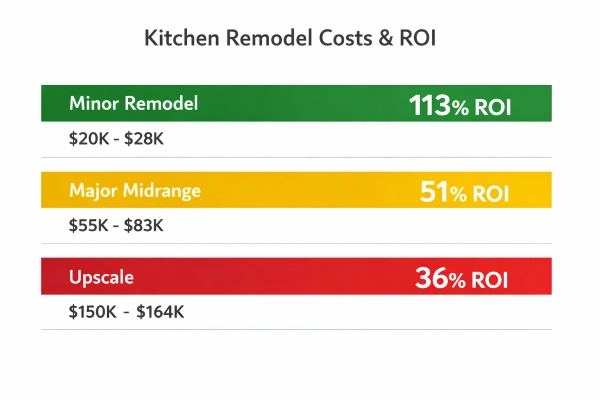
A minor kitchen remodel returns roughly 113% of its cost at resale, according to the 2025 JLC Cost vs. Value Report. A major midrange remodel? Only about 51%. And a full upscale gut job recoups just 36%. Those three numbers should change how you plan every dollar of your kitchen renovation.
What adds the most value to a kitchen remodel comes down to focused upgrades that buyers actually care about, not the flashiest finishes or the biggest scope of work. In 2026, the upgrades that return the most are refreshed cabinetry, durable countertops, energy-efficient appliances, and better lighting. The homeowners who get burned are the ones who rip everything out when a smarter, smaller project would’ve earned them more equity.
This article won’t cover full architectural redesigns or luxury additions like wine cellars. Those projects have their place, but the ROI data doesn’t support them for most homeowners. Instead, we’re focusing on the upgrades where every dollar spent comes back (and then some) when it’s time to sell.
How Much Does a Kitchen Remodel Cost in 2026?
The national median for a major kitchen remodel sits at $55,000, per the 2026 Houzz Kitchen Trends Study. Minor remodels (think new countertops, cabinet refacing, and appliance swaps) come in around $20,000. If your kitchen is 250 square feet or larger, expect the major remodel median to jump to $75,000.
Those are medians. The actual range is wide.
Angi pegs the national average at $26,946, with a typical range of $14,586 to $41,526. JLC’s Cost vs. Value data puts the midrange major remodel at $82,793 and the upscale version at $164,104. So “average cost” depends entirely on what you’re doing and where you live.
| Remodel Tier | Typical Cost Range | Avg. ROI at Resale |
| Minor/midrange (reface, counters, appliances) | $20,000–$28,458 | ~113% |
| Major/midrange (full cabinets + appliances, same layout) | $55,000–$82,793 | ~51% |
| Major/upscale (custom everything, layout changes) | $150,000–$164,104 | ~36% |
Sources: JLC 2025 Cost vs. Value Report (119 markets); 2026 Houzz Kitchen Trends Study; Angi (updated Nov. 2025)
That table is the single most important thing in this article. Minor remodels don’t just cost less. They earn more per dollar. I’ve seen homeowners sink $90,000 into a gut renovation and recover $45,000 at sale. Their neighbor spent $25,000 on cabinet refacing, quartz counters, and new appliances, then got $28,000 back. The neighbor won.
Does Your Location Change Kitchen Remodel ROI?
Yes, and it matters more than most people realize. Regional labor and material costs create a spread of 20–50% between markets.
| Region | Cost Range |
| Northeast | $10,800–$40,400 |
| Southeast | $12,000–$32,200 |
| Midwest | $10,300–$34,300 |
| West (all sub-regions) | $12,350–$61,100 |
Source: Angi/HomeAdvisor, 2025 data
The West Coast has the widest variance and the highest ceiling. But here’s the twist: ROI is often stronger in high-home-value markets. A Fixr analysis of JLC data shows California minor remodels averaging 122%+ returns. If your home is valued above $500,000, even modest upgrades move the appraisal needle faster because buyers in that bracket expect an updated kitchen as a baseline.
Midwest and Southeast homeowners get the best bang for the dollar on a cost basis, but the absolute dollar return may be smaller because home values are lower. You can’t think about ROI in a vacuum. A 113% return on a $20,000 project in Ohio looks different from 113% on $35,000 in San Diego.
What Kitchen Upgrades Return the Most Money?
Not all upgrades are equal. Some carry their weight at resale. Others are money pits dressed up as “investments.” Here’s where the data points, ranked by impact.
Cabinetry: Reface or Replace?
Cabinets eat 25–35% of most kitchen budgets, so getting this decision right is a big deal.
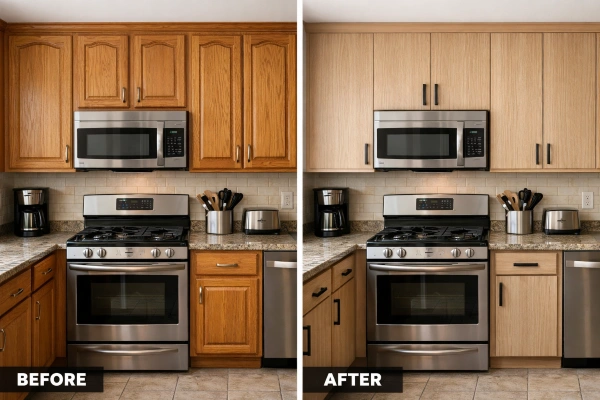
Cabinet refacing (new doors and drawer fronts on existing boxes) runs $5,000–$15,000 and sits squarely in the minor remodel category. That’s the category returning 113%. Full custom cabinets run $20,000–$50,000+ and push you into major-remodel territory where returns drop fast.
The NKBA 2026 Kitchen Trends Report shows wood-grain cabinets growing at 59% popularity and slab-style doors hitting 69%. Both trends favor refacing because you can swap door styles without gutting the kitchen. Transitional/timeless styles are what 72% of designers recommend for resale appeal.
One thing almost nobody talks about: federal tariffs on imported cabinets hit 25% in late 2025, with a potential jump to 50% delayed until at least 2027. If you’re buying imported cabinets, expect costs roughly 10% higher than last year. Domestic sourcing avoids the tariff hit and the shipping delays that come with it.
Are Countertops Worth the Splurge?
Countertops account for 10–15% of most budgets, and the material choice signals quality to buyers faster than almost anything else in the room.
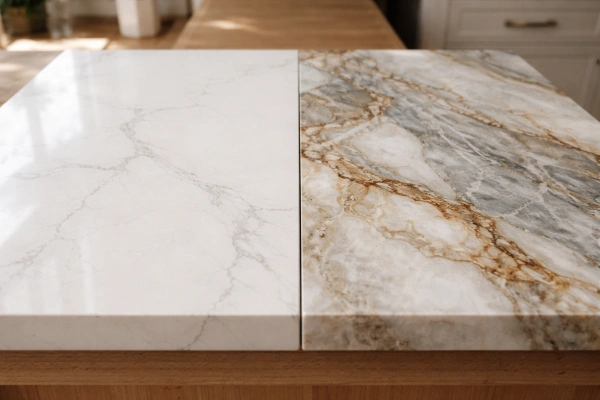
Quartz is still the default recommendation for most kitchens. It’s non-porous, low-maintenance, and comes in enough colors and patterns to match any design direction. But the NKBA 2026 report highlights natural quartzite as the rising pick, with 62% of designers specifying it. Quartzite is harder than granite, lasts 5–10 years longer than quartz by installer estimates, and has a depth that engineered stone can’t replicate.
Actually, the quartzite story isn’t all positive. Installers I’ve talked to report that it etches if you don’t seal it regularly, and it’s pricier than quartz by 20–40%. For a family that cooks daily and doesn’t want to fuss over maintenance, quartz is the better call. For resale in a higher-end market? Quartzite is worth the premium.
Laminate still has a place in budget remodels. It’s cheap, easy to replace, and today’s laminates look far better than the stuff from 10 years ago. If you’re spending $20,000 total, don’t blow $8,000 on stone countertops. Laminate at $2,000 keeps you in the minor remodel bracket where ROI is strongest.
How Much Value Do New Appliances Add?
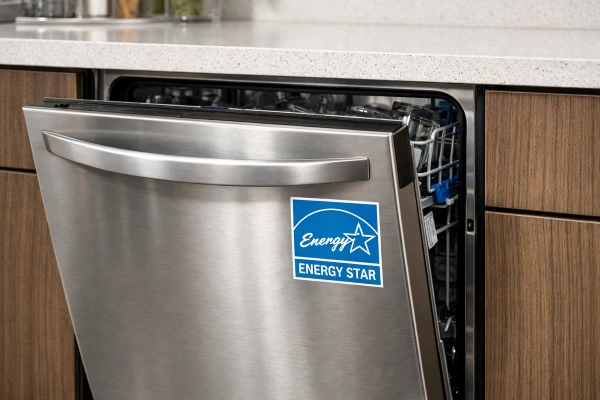
Appliances represent 15–20% of the budget and sit in the medium-high ROI tier. The goal isn’t buying the most expensive appliances. It’s buying Energy Star-rated models that lower utility bills and check the “updated kitchen” box for buyers.
A full appliance package (refrigerator, range, dishwasher, microwave) runs $3,000–$8,000 for mid-tier brands. You don’t need a $4,000 refrigerator. A $1,500 Energy Star model from a reputable brand checks every box a buyer cares about.
Smart appliances (Wi-Fi ovens, connected refrigerators) are growing but remain a “nice-to-have” rather than a value driver at resale. The 2026 Houzz study shows 33% of homeowners citing financial means as a motivation, meaning buyers are pragmatic. They want appliances that work and save energy, not ones that send push notifications.
Does Lighting Actually Affect Kitchen Value?
More than most homeowners expect.
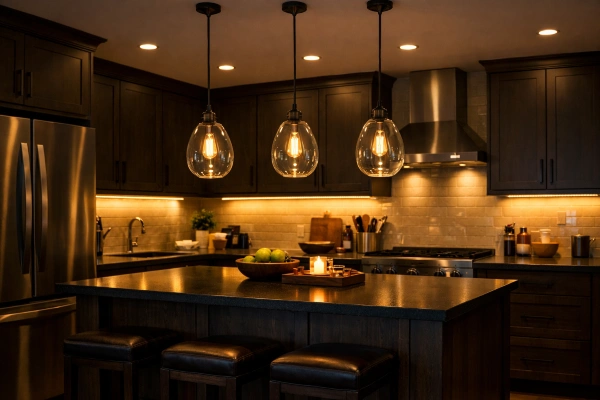
The NKBA 2026 report found that 82% of designers prioritize under-cabinet lighting and 72% specify interior cabinet lighting as a standard recommendation. Good lighting makes a kitchen feel bigger, cleaner, and more modern without moving a single wall.
Under-cabinet LED strips run $200–$500 installed. Pendant lights over an island cost $300–$1,000. A full lighting upgrade with dimmer switches, task lighting, and ambient layers might hit $2,000–$4,000. For a project that costs under $5,000, the perceived value increase is outsized.
One code change to watch in 2026: the updated National Electrical Code (NEC), already adopted in states like California, now prohibits exposed outlets below countertops on islands and peninsulas. Countertop-level receptacles are required instead, adding $200–$800 per island. If you’re upgrading lighting, factor in the electrical compliance cost while your electrician is already on-site.
What About Flooring, Paint, and Finishes?
These fall into the “low cost, solid return” category.
Flooring runs 7–10% of a kitchen budget. Luxury vinyl plank (LVP) has become the most popular choice for a reason: it’s waterproof, comfortable underfoot, mimics wood convincingly, and costs $3–$7 per square foot installed. Hardwood looks great but is sensitive to moisture in a kitchen environment. Tile is durable but feels cold and hard if you spend a lot of time standing.
Paint is the cheapest upgrade with the highest visual impact. A fresh coat of paint in a warm neutral tone costs $200–$500 for a kitchen. Buyers notice fresh paint immediately, and it costs almost nothing relative to the budget.
For a team that knows how to position remodeling businesses online, these low-cost upgrades are the kinds of details that photograph well and show up in listing descriptions.
How Should You Budget for a Kitchen Remodel?
Set a range, not a fixed number. Then add 10–15% for the unexpected.
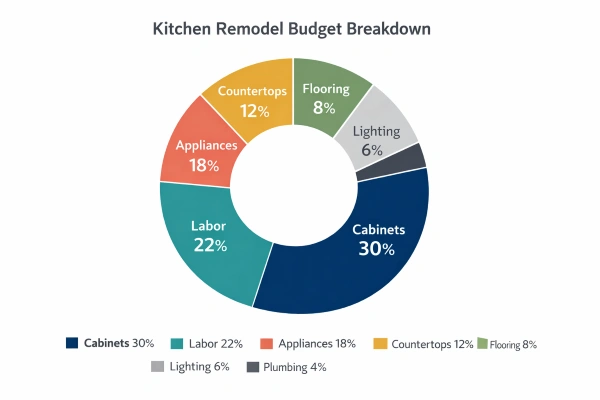
Here’s where the money typically goes:
| Category | % of Budget | Dollar Range ($25K project) |
| Cabinets (reface or replace) | 25–35% | $6,250–$8,750 |
| Countertops | 10–15% | $2,500–$3,750 |
| Appliances | 15–20% | $3,750–$5,000 |
| Flooring | 7–10% | $1,750–$2,500 |
| Lighting | 5–7% | $1,250–$1,750 |
| Plumbing/fixtures | 6–10% | $1,500–$2,500 |
| Labor | 20–25% | $5,000–$6,250 |
The biggest budgeting mistake I see? Homeowners treating a contractor’s ballpark estimate as a final number. Industry data from Houzz shows change orders add 15–25% on top of initial quotes. Get line-item bids, not ballparks.
The second biggest mistake is changing the layout. Moving plumbing and electrical adds $10,000–$20,000+ in piping, wiring, and code compliance costs. For most kitchens, keeping the existing layout and upgrading the surfaces, fixtures, and appliances produces a far better return.
What Design Choices Hold Up at Resale?
The NKBA’s 2026 report surveyed designers, remodelers, and architects. Their consensus: transitional, timeless styles (recommended by 72%) and natural materials outperform trendy designs at resale.
Does Kitchen Layout Still Matter?
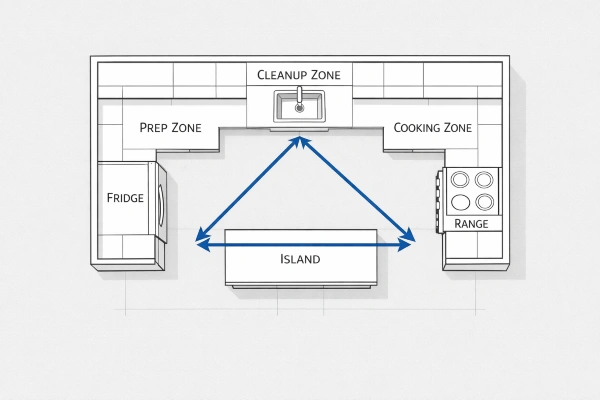
The classic “work triangle” (sink, stove, refrigerator in a triangular path) is the standard, but modern designers are moving toward a “work trapezoid” that adds a fourth point, usually a prep area or second sink. The real principle is simple: keep the three main stations close enough for a smooth workflow but far enough apart that two people aren’t bumping into each other.
Islands continue to grow in popularity. The 2026 Houzz study shows 76% of homeowners adding built-in features, with 47% adding pantry cabinets as the top pick. Islands provide extra counter space, storage, and casual seating, three things buyers consistently look for.
How Do Storage Upgrades Add Value?
Butler’s pantries and prep kitchens are gaining popularity fast. The NKBA 2026 report shows 67% of these secondary spaces focus on small-appliance storage. It’s not about the size of the pantry. It’s about getting appliances off the counter.
Pull-out shelves, deep drawers, and interior organizers are inexpensive add-ons ($50–$200 per cabinet) that make the kitchen feel bigger than it is. Open shelving has visual appeal for listing photos but isn’t as practical for daily use. If you’re keeping the home for a while, go with closed storage. If you’re selling soon, a mix of both reads well.
What About Sinks and Faucets?
Plumbing fixtures account for 6–10% of the budget. A new sink and faucet can run as little as $500 or as much as $3,000, depending on material and style.
Undermount sinks are the standard for stone countertops. Farmhouse/apron-front sinks photograph well and appeal to the transitional-style buyer. Touchless faucets are a practical upgrade that signals a modern kitchen without a high price tag ($250–$600).
Skip the water filtration system unless your local water quality demands it. It’s a fine feature, but it doesn’t move the resale needle.
Do Eco-Friendly Upgrades Add Kitchen Value?
Yes, but not for the reason most articles suggest.
Eco-friendly upgrades add value because they lower operating costs, not because buyers care about “going green” in the abstract. Energy Star appliances save $100–$300 per year on utility bills. LED lighting uses 75% less energy than incandescent and lasts 15–25 times longer. Low-flow faucets reduce water usage without sacrificing pressure.
Harvard’s Joint Center for Housing Studies projects home improvement spending hitting $524 billion in early 2026. A chunk of that is driven by efficiency upgrades, with homeowners spending to reduce long-term costs rather than chasing aesthetic trends.
Sustainable materials like bamboo flooring and reclaimed wood cabinetry have niche appeal. They won’t hurt resale, but they won’t drive it either unless you’re in a market (Portland, Austin, parts of California) where sustainability is a top buyer priority.
What Adds the Most Value to a Kitchen Remodel? The Bottom Line
Spend less. Upgrade smarter. Stay in the minor-remodel bracket if resale ROI is your goal.
The 2025 Cost vs. Value data makes it clear: a $20,000–$28,000 minor kitchen remodel returning 113% beats a $82,000+ major remodel at 51% every time. Reface your cabinets instead of replacing them. Pick quartz or quartzite countertops. Swap in Energy Star appliances. Upgrade the lighting. Paint the walls.
That formula isn’t exciting. It won’t get you on a design show. But it’s backed by data from 119 markets, and it works whether you’re selling next year or building equity for later.
FAQs
Does a minor or major kitchen remodel give better ROI in 2026?
A minor midrange kitchen remodel returns roughly 113% of its cost at resale, while a major midrange remodel returns about 51%. The data comes from the JLC 2025 Cost vs. Value Report, which covers 119 U.S. markets. Smaller, focused upgrades like cabinet refacing, new countertops, and appliance swaps consistently outperform large-scale gut renovations.
How much does a kitchen remodel cost on average in 2026?
The national median for a major kitchen remodel is $55,000, according to the 2026 Houzz Kitchen Trends Study. Minor remodels average $20,000 nationally. Angi’s data shows a broader range of $14,586 to $41,526, depending on scope and location. Costs run highest in the western U.S., where labor and materials can be 20–50% above the national average.
What adds the most value to a kitchen remodel for resale?
The highest-value upgrades are cabinet refacing or replacement, quartz or quartzite countertops, Energy Star-rated appliances, and upgraded lighting. These items account for the bulk of a minor remodel budget and fall within the remodel tier that returns 113% at resale. Layout changes and luxury finishes look impressive but rarely pay back their cost.
Do 2026 tariffs affect kitchen cabinet costs?
Yes. Federal tariffs of 25% on imported cabinets took effect in late 2025, with a potential increase to 50% delayed until at least 2027. Imported cabinet prices have risen roughly 10% as a result. Homeowners can avoid the tariff markup and shipping delays by choosing domestically manufactured cabinets.
Will 2026 electrical code changes add cost to my remodel?
The 2026 National Electrical Code (NEC), already adopted in states like California, requires countertop-level receptacles on islands and peninsulas instead of below-counter exposed outlets. This adds $200–$800 per island. Combined with JA8-compliant lighting and GFCI/AFCI upgrades, hidden code compliance costs can reach $1,000–$3,000 or more.
Is it worth expanding the kitchen footprint for resale value?
Expanding the kitchen increases functionality and entertaining appeal. The 2026 Houzz study shows larger kitchens (250+ sq. ft.) carry a median major-remodel cost of $75,000. About 76% of industry professionals expect kitchen footprints to grow. But expansion pushes you into the major-remodel tier where ROI drops to 51% or lower, so the math only works if your home’s value supports the investment.
Should I DIY my kitchen remodel to save money?
Labor accounts for about 25% of total kitchen remodel costs, or roughly $2,500–$6,000 on a typical project. DIY can save that money but risks voiding manufacturer warranties, creating code violations, and producing lower-quality results. Backsplash installation and painting are reasonable DIY projects. Plumbing, electrical, and countertop installation should go to licensed professionals.

Michael Vale has over 5 years of experience helping clients improve their business visibility on Google. He combines his love for teaching with his entrepreneurial spirit to develop innovative marketing strategies. Inspired by the big AI wave of 2023, Michael Vale now focuses on staying updated with the latest AI tools and techniques. He is committed to using these advancements to deliver great results for his clients, keeping them ahead in the competitive online market.