
Can You Remodel A Kitchen For $25,000 In 2026?
Short answer: yes, but only if you understand where that $25,000 ends and where the surprises begin.
The national average for a kitchen remodel sits right around $26,950 as of March 2026, according to Angi. That puts a $25,000 budget just barely below the midpoint for a cosmetic-to-moderate scope of work. You’re not getting a full gut renovation at this number. You’re getting new surfaces, better appliances, and a kitchen that looks and works significantly better than what you have now.
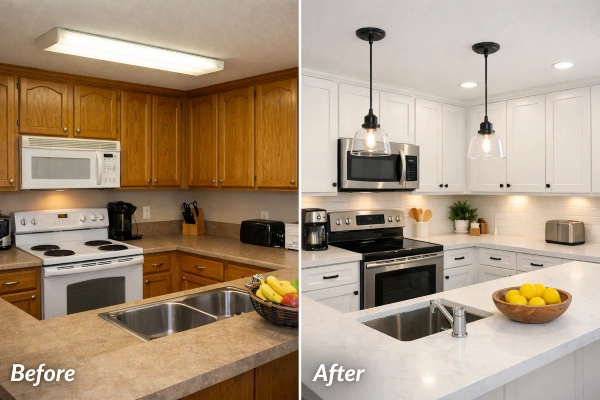
A $25,000 kitchen remodel covers a cosmetic-to-moderate renovation that includes cabinet refacing or replacement, mid-range countertops, updated appliances, new flooring, and modern lighting. It assumes you’re keeping the existing layout and not relocating plumbing or electrical.
That framing matters. Most homeowners walk into this process thinking $25,000 gets them everything. It doesn’t. But it gets them a lot more than they expect if they spend it in the right places (and stop spending it in the wrong ones). I won’t cover full luxury gut renovations here. That’s a different conversation with a different budget. This article is about squeezing real value from every dollar in a realistic budget.
What Does a Kitchen Remodel Actually Cost in 2026?
The range is wider than most articles admit. Angi’s 2026 cost analysis puts the full spread at $14,586 on the low end to $41,536 on the high end. HomeAdvisor’s numbers land in nearly the same window. NerdWallet, citing a 2025 Hanley Wood study, pegs a minor midrange kitchen remodel specifically at $28,458.
So if you’re sitting at $25,000, you’re in the lower-middle band. Not budget. Not luxury. The zone where smart decisions separate a kitchen that feels like a $50,000 job from one that looks like you ran out of money.
Here’s where the dollars actually go.
How Much Do Cabinets Cost?
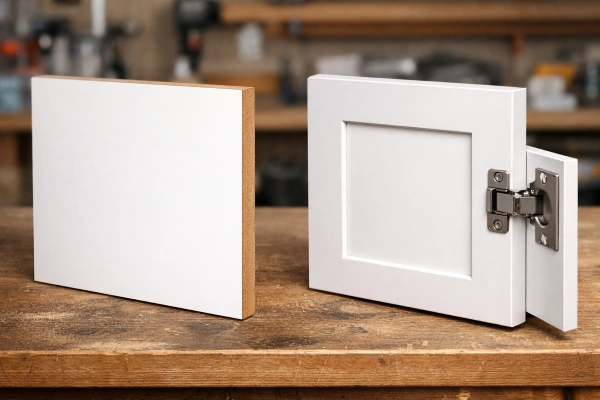
Cabinets eat the biggest chunk. Custom options run $15,000 to $30,000 on their own, which obviously blows a $25,000 budget before you buy a single appliance. Semi-custom cabinets fall between $5,000 and $15,000, and stock cabinets come in under $5,000.
Here’s what most articles won’t tell you: stock cabinets look great on a showroom floor, but contractors consistently report fit issues, warped doors, and hardware that doesn’t hold up. I’ve seen enough projects where the “savings” on cheap cabinets got eaten by labor hours fixing installation problems. Semi-custom is the sweet spot for this budget. You get better build quality, more finish options, and cabinets that actually fit your space without expensive on-site modifications.
What Will Countertops Run You?
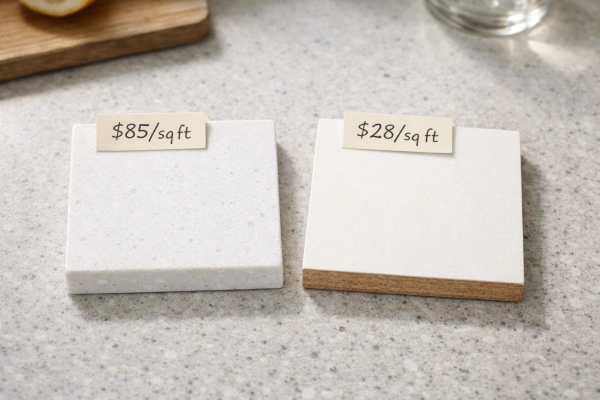
Material choice drives everything here. Laminate runs $20–$40 per square foot installed but looks like laminate and lasts 10–15 years. Quartz costs $60–$120 per square foot, looks significantly better, and lasts 25+ years.
For a medium kitchen, budget $3,000–$5,000 for quartz. That’s a big piece of $25,000, but countertops are the single most visible surface in your kitchen. Skimping here to save $2,000 on laminate is a trade-off I almost never recommend. NKBA’s 2026 Kitchen Trends Report shows quartzite and natural stone gaining ground over engineered options, but for a $25K scope, quartz is still the practical pick.
What About Appliances?
Plan for $3,500–$6,000 on a mid-range appliance package. You don’t need commercial-grade equipment to get a kitchen that performs well. What you need are appliances that match your actual cooking habits.
One thing that’s shifted in the last year: induction cooktops showed up all over KBIS 2026 as a mainstream option, not just a high-end one. If you’re replacing a range anyway, induction is worth pricing out. California’s 2026 energy code now requires “electric-ready” infrastructure in kitchens, and that requirement will likely spread to other states.
How Much Does Kitchen Flooring Cost?
Expect $2,000–$5,000 depending on material and kitchen size. Luxury vinyl plank (LVP) dominates this budget range because it’s water-resistant, durable, and runs $3–$7 per square foot installed. Mid-range hardwood doubles or triples that number.
LVP gets a bad reputation from people who installed the cheap stuff five years ago. The current generation of rigid-core LVP looks and feels dramatically better. For a $25,000 total budget, it’s the smart play for flooring.
Does Lighting Really Matter That Much?
More than most people think. Budget $500–$2,500 for fixtures. Pendant lights over an island, under-cabinet task lighting, and recessed ceiling lights are the three-layer combo that makes a kitchen feel finished. Skip any one of those layers and the room feels flat.
This is also one area where DIY actually makes sense. Swapping out fixtures is straightforward electrical work, and doing it yourself saves $300–$800 in labor.
How Much Goes to Labor?
Here’s where 2026 math diverges from the advice you’ll find in older articles. Labor now accounts for 25–35% of total project cost, up from historical averages. The NAHB’s Fall 2025 Construction Labor Market Report found that the skilled-labor shortage carries a $10.8 billion annual economic impact on residential construction. Residential wages rose 9.2% year-over-year as of mid-2025.
On a $25,000 project, expect to spend $6,000–$8,750 on labor. That’s not a number you can negotiate down easily. Hiring a qualified remodeling contractor costs more than it did three years ago because qualified people are harder to find.
Where Should You Spend vs. Save on a $25,000 Kitchen Remodel?
Most “tips to save money” advice is generic to the point of being useless. Here’s the actual decision framework I’d use.
Spend on cabinets and countertops. These two categories define whether your kitchen reads as “remodeled” or “updated a few things.” Allocate 45–55% of your budget here.
Save on flooring and lighting. Not by going cheap. By going smart. LVP over hardwood. DIY fixture installation. Shopping appliance packages during holiday sales instead of buying pieces individually.
Don’t touch the layout. The second you move a sink, relocate gas lines, or knock down a wall, your $25,000 becomes $40,000. Layout changes trigger plumbing, electrical, and structural work that burns through a budget fast. This is the single most expensive mistake on projects at this price point.
Actually, that framing isn’t quite right. The most expensive mistake isn’t moving a sink. It’s not finalizing selections before work starts. Contractor forums are full of stories about homeowners who changed their mind on cabinet finish mid-project or swapped countertop materials after templating. Change orders on a mid-size kitchen remodel routinely add $10,000–$50,000. One Reddit thread from 2025 described a project that went $175,000 over budget, with the kitchen being a major portion. Lock your decisions before demolition day. Period.
Does a Phased Kitchen Remodel Make Sense?
If your dream kitchen costs $40,000 but you have $25,000 now, phasing can work. Start with cabinets and countertops. Add appliances in phase two. Finish with flooring and lighting.
The catch: phasing means living in a half-finished kitchen for months and paying mobilization costs twice. For some homeowners, that’s fine. For others, it creates more stress than it’s worth. I’d only recommend it if the gap between your budget and your scope is under 40%.
What Can $25,000 Actually Buy? A Realistic Breakdown
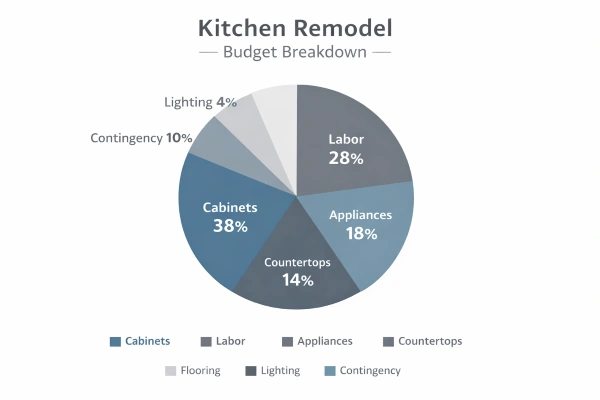
| Category | Budget Range | % of Total |
| Cabinets (semi-custom) | $7,000–$12,000 | 28–48% |
| Countertops (quartz) | $3,000–$5,000 | 12–20% |
| Appliances (mid-range) | $3,500–$6,000 | 14–24% |
| Flooring (LVP or tile) | $2,000–$4,000 | 8–16% |
| Lighting and fixtures | $500–$1,500 | 2–6% |
| Labor | $6,000–$8,750 | 24–35% |
| Contingency (10%) | $2,500 | 10% |
That contingency line is non-negotiable. Every contractor I’ve worked with says the same thing: homeowners who skip the buffer end up cutting corners at the finish line, which is exactly where quality shows the most.
Notice the math gets tight. If you go heavy on cabinets ($12,000) and max out appliances ($6,000), you’ve already spent $18,000 before touching countertops, flooring, or labor. A $25,000 kitchen remodel requires trade-offs. The table above works only if you pick the mid-point of each range, not the top.
How Long Does a $25,000 Kitchen Remodel Take?
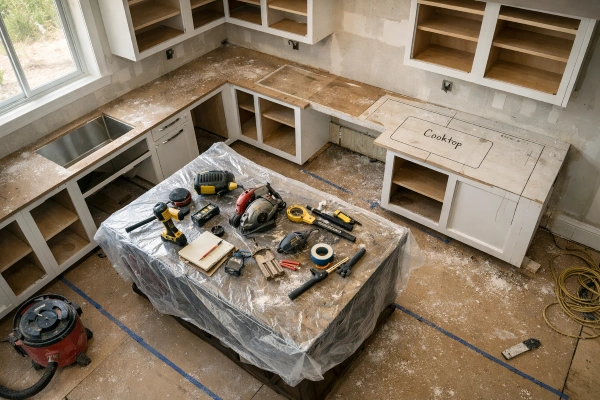
For a moderate-scope project with no layout changes, plan for 6–10 weeks from demolition to final walkthrough. Add 2–4 weeks of design and material selection on the front end.
The 2026 labor market makes timelines less predictable than they used to be. NAHB’s February 2026 forecast noted remodeling demand growing 3% this year, which means contractors are busy. That’s one more reason to plan your remodel budget carefully before calling for bids. Book early. If a contractor can start next week, ask why nobody else hired them.
One more timing factor: cabinet lead times. Semi-custom cabinets take 4–8 weeks to manufacture and deliver. Order them before you finalize your start date, not after.
Does a $25,000 Kitchen Remodel Pay Off at Resale?
This is where the data gets interesting. The 2025 Zonda/JLC Cost vs. Value Report found that a minor midrange kitchen remodel costing $28,458 recoups 113% of its cost at resale. That’s $32,141 in added home value. It’s one of the highest-ROI interior projects you can do.
Compare that to a major upscale kitchen remodel at $164,104, which only recoups 36%. The math is clear: moderate kitchen remodels add more value per dollar than high-end ones. If you’re remodeling partly for resale, a $25,000 scope is actually a smarter investment than a $75,000 one.
But don’t remodel just for ROI. Remodel because you cook dinner in a kitchen with 1990s oak cabinets and laminate that’s peeling at the seams. The resale bump is a bonus, not the business case.
What Tariff Changes Could Affect Your Kitchen Remodel Budget?
This is the wildcard nobody was talking about two years ago. Tariffs on imported cabinets and vanities ramped up to 50% through late 2025, pushing prices up on popular import lines. The Supreme Court struck down broad tariff authority in February 2026, but new Section 301 investigations are already underway.
Contractors report 8–20% price swings on imported cabinetry since late 2025. If you’re buying domestic semi-custom cabinets, this affects you less. If your bid includes imported RTA (ready-to-assemble) cabinets, ask your contractor whether the quoted price includes a tariff buffer. Most don’t.
Questions to Ask Your Contractor That Most People Forget
Before signing any contract, ask these six questions. I’ve seen projects go sideways because homeowners didn’t ask even one of them.
- Can you provide a line-item breakdown with allowances for unknowns?
- What’s your change-order policy, and who pays for site discoveries?
- Will you guarantee a completion date with penalties for delays?
- Are your subcontractors licensed, insured, and carrying worker’s comp?
- What temporary kitchen setup do you provide during construction?
- Can I see three recent projects at this budget with full costs and client references?
If the contractor hesitates on any of these, that tells you something. Avoiding common remodeling mistakes starts before you ever pick up a hammer. And if you’re working with a team that understands your remodeling business, they’ll tell you the same thing: preparation outperforms improvisation every time.
FAQs
Can I really get a full kitchen remodel for $25,000 in 2026?
You can get a cosmetic-to-moderate kitchen remodel for $25,000, but not a full gut renovation. The national average sits at $26,950 (Angi, March 2026), so $25,000 covers new cabinets, countertops, appliances, flooring, and lighting as long as you keep the existing layout. Moving plumbing or walls pushes costs well beyond this range.
What’s the biggest cost in a kitchen remodel?
Cabinets take the largest share, typically 28–48% of total project cost. Semi-custom options run $5,000–$15,000, while custom cabinets can hit $30,000 on their own. For a $25,000 budget, semi-custom is the sweet spot between quality and affordability.
How long does a $25,000 kitchen remodel take?
Plan for 6–10 weeks of construction after a 2–4 week design and material selection phase. Semi-custom cabinet lead times add 4–8 weeks before construction even begins. Total timeline from first design meeting to final walkthrough is typically 3–5 months.
Is a $25,000 kitchen remodel worth it for resale value?
Yes. The 2025 Zonda/JLC Cost vs. Value Report shows a minor midrange kitchen remodel ($28,458 cost) recoups 113% at resale, adding $32,141 in home value. That’s one of the highest interior-project ROI figures in the report. Major upscale remodels ($164,104) only recoup 36%.
Should I tell my contractor my exact budget upfront?
Many contractors advise against it. Sharing your number upfront can lead to padded estimates or corner-cutting to hit a target. A better approach: ask for detailed line-item quotes on your specific scope of work first, then negotiate from there.
How do 2026 tariffs affect kitchen remodel costs?
Tariffs on imported cabinets and vanities reached 50% in late 2025. While a February 2026 Supreme Court ruling created some refund uncertainty, new trade investigations are ongoing. Contractors report 8–20% price swings on imported cabinetry. Ask whether your quote includes a tariff buffer, especially on imported products.
What hidden costs catch homeowners off guard during a kitchen remodel?
Permits, dumpster/disposal fees, temporary kitchen setups, and unexpected electrical or plumbing issues behind walls are the most common surprises. Change orders from mid-project design changes add $10,000–$50,000 on moderate projects. Building a 10% contingency into your budget from day one is the best protection.

Michael Vale has over 5 years of experience helping clients improve their business visibility on Google. He combines his love for teaching with his entrepreneurial spirit to develop innovative marketing strategies. Inspired by the big AI wave of 2023, Michael Vale now focuses on staying updated with the latest AI tools and techniques. He is committed to using these advancements to deliver great results for his clients, keeping them ahead in the competitive online market.