
Can You Live In Your Home While Remodeling?
Yes, you can live in your home while remodeling. But “can” and “should” aren’t the same thing. For small projects (a guest bathroom, a basement finish, a laundry room), staying put is usually fine. For a kitchen gut, a whole-house renovation, or any project touching your only bathroom, moving out is almost always the smarter call.
I’ve watched this play out across hundreds of renovation projects. The homeowners who move out for major work finish faster, spend less overall, and come back loving the result. The ones who tough it out? About half say they’d never do it again.
Living in your home during a remodel means dealing with dust in your coffee, strangers in your hallway at 7 a.m., and weeks without a functioning kitchen. It’s doable for the right project. But the industry keeps underselling how hard it really is, and I think that does homeowners a disservice.
This article breaks down when staying makes sense, when it doesn’t, what it actually costs either way, and how to survive the process if you decide to stick around. We won’t cover DIY renovations or cosmetic refreshes like painting and swapping fixtures. Those don’t create the kind of disruption that forces this decision.

Here’s the quick framework. If your project checks two or more of these boxes, plan to move out:
| Factor | Stay | Move Out |
| Rooms affected | 1 room, not kitchen or only bath | Kitchen, only bathroom, or 2+ rooms |
| Timeline | Under 4 weeks | 6+ weeks |
| Household members | Adults only, flexible schedule | Young kids, elderly, pets with anxiety |
| Scope of work | Cosmetic or single-trade | Structural, plumbing, electrical gut |
| Your work situation | Leave for work daily | Work from home |
If you’re on the fence, lean toward moving out. That’s not the popular advice, but it’s the honest one.

How Stressful Is It to Live in Your Home While Remodeling?
More stressful than most people expect. And the stress doesn’t come from one big thing. It comes from dozens of small disruptions that stack up over weeks.
Your morning routine falls apart first. The kitchen is torn down, so you’re microwaving oatmeal in the bedroom and washing dishes in the bathroom sink. Contractors arrive between 7:00 and 7:30 a.m., so sleeping in isn’t an option. You’re living out of boxes in two rooms while the rest of the house looks like a demolition site.
That part everyone anticipates. What they don’t anticipate is the emotional toll. Seeing your home stripped to the studs hits different than you’d expect. Bare framing, exposed wiring, holes in the subfloor. There’s a phase in every major remodel (usually around drywall) where the house looks worse than it did before work started. Contractors call it the “ugly stage,” and it lasts longer than the renders suggest.
According to the 2025 Houzz & Home Study (which surveyed over 22,000 homeowners), 54% of homeowners renovated in 2024. The median spend was $20,000. And disruption ranked among the top concerns for homeowners planning 2026 projects. Harvard’s Joint Center for Housing Studies projects annual homeowner spending on improvements will hit $522 billion by the end of 2026, which tells you more people are facing this exact stay-or-go decision right now than at any point in the last decade.
Kids and pets make everything harder. Nap schedules get wrecked by nail guns. Dogs lose their minds over strangers coming and going. Cats find their way into construction zones no matter how good your barriers are. One contractor I know described it this way: every occupied remodel adds at least two “crisis moments” per week that have nothing to do with the actual building.
The fix isn’t complicated. If you stay, set up one room that construction doesn’t touch. Your bedroom, ideally. Make it your refuge. Seal the door gaps with painter’s tape. Run an air purifier. And schedule weekly check-ins with your contractor at the site instead of hovering daily. Distance gives you perspective, and perspective keeps you from making panic decisions at the ugly stage.
Moving Out During a Remodel Can Save You Money
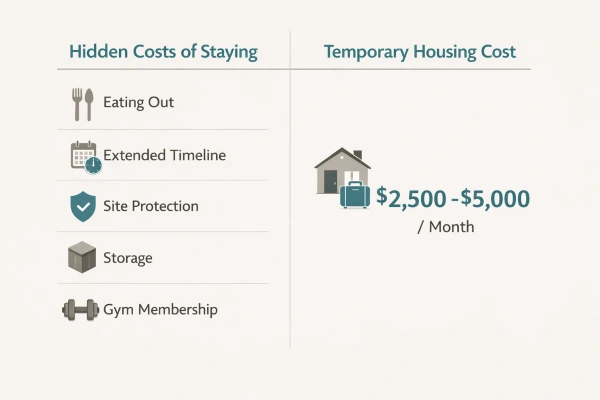
This is the part that surprises people. Temporary housing costs money, obviously. But staying in your home during a major remodel has hidden costs that add up fast.
The biggest one is timeline inflation. When your contractor has to work around your family’s schedule (out by 5:30 p.m., can’t start demo until the kids leave at 8:15 a.m.), they lose productive hours every single day. Tasks that would’ve been finished by end of day get pushed to tomorrow. Tomorrow’s tasks get pushed to next week. On a 12-week kitchen remodel, those lost hours can stretch the project by 2 to 4 extra weeks.
Extra weeks means extra labor costs you’re paying for. And that’s before you count site protection. Your contractor has to spend time each evening cleaning up construction debris, laying down floor protection, sealing off work zones, and managing air quality so your family can come home to a livable space. On a vacant house, a crew sweeps up and stacks tools in 15 minutes. On an occupied house, end-of-day cleanup can take an hour or more. You’re paying for that time.
Then there’s the stuff you don’t think about. Eating out because your kitchen is gutted runs $400–$800 a month for a family of four, depending on where you live. Temporary storage for displaced furniture: $100–$300 a month. Gym membership for showering if your bathroom is down: another $30–$50 a month. A few hotel nights during the worst demolition phase: $150–$300 a night.
According to Angi’s 2026 data, the average household spent $9,288 on home improvement projects in 2025. On a major remodel, those hidden “living in” costs can quietly add $3,000–$8,000 to your total depending on project length. Many contractors say these costs often match or exceed what you’d pay for a short-term rental nearby.
A furnished Airbnb or VRBO within 15 minutes of your house typically runs $2,000–$5,000 a month for a family. That sounds steep until you factor in the compressed timeline, the avoided site-protection charges, and the takeout budget you won’t blow through. If you’re trying to save money on your home remodel, building temporary housing into your budget from day one is one of the least obvious but most effective ways to do it. The math often breaks even. Sometimes it tips in favor of moving out.
Is It Safe to Stay in Your Home During Construction?
For small, contained projects, yes. For major work involving structural changes, plumbing, or electrical, the honest answer is: it depends on your household.
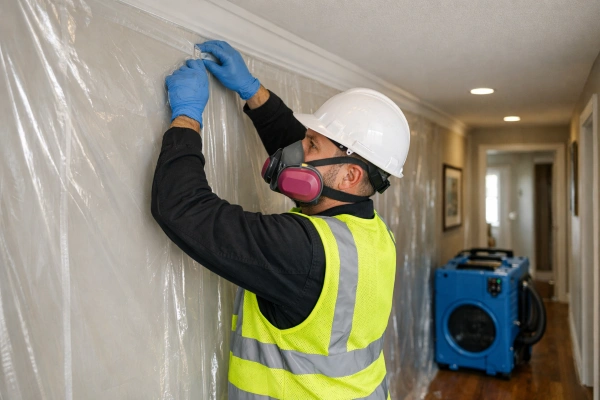
Construction sites produce airborne particulates that you can’t always see. Drywall dust, sawdust, insulation fibers, and (in older homes) potentially lead paint dust or asbestos fibers. Professional crews use HEPA air scrubbers and plastic containment barriers, but no system captures 100% of the particles. Contractors wear respirator masks for a reason.
If everyone in your home is a healthy adult, that residual dust exposure is usually manageable with good air filtration and daily cleaning. But pregnant women, infants, elderly family members, and anyone with asthma or respiratory conditions face real risk. The EPA has published guidelines on indoor air quality that flag construction dust as a concern for sensitive populations. This isn’t something to brush off.
Beyond dust, there are physical hazards. Open wall cavities, exposed nails, power tools left on sawhorses, extension cords running across hallways. Good contractors seal off work zones with locked barriers. But I’ve seen kids duck under plastic sheeting more times than I can count. Pets are even worse. A dog doesn’t understand that the open subfloor near the plumbing rough-in is a 4-foot drop into the crawlspace.
The practical rule I use: if your household includes anyone under 10 or over 70, and the project involves demolition of load-bearing walls, full plumbing rerouting, or electrical panel work, move out during those specific phases. You don’t have to leave for the entire project. But during the 2–3 weeks of heaviest demo and rough-in, temporary relocation protects your family and lets the crew work without liability anxiety.
Your Remodel Finishes Faster When the House Is Empty
An empty house isn’t just more convenient for your contractor. It’s measurably faster.
When a crew has full run of the space, they can stage materials in adjacent rooms, run multiple trades simultaneously, and work extended hours when they’re pushing to hit a milestone. None of that happens when a family is sleeping upstairs or a toddler is watching Bluey in the next room.
I’ve talked to project managers who estimate that occupied renovations take 15–25% longer than the same scope on a vacant house. On a $55,000 large kitchen remodel (the 2025 Houzz median for kitchens over 200 square feet), that time difference translates to real money. Two extra weeks of labor at $500–$800 per day isn’t pocket change. And those kitchen numbers only tell part of the story. Knowing what a kitchen renovation actually costs in 2026 helps you understand how much those delay weeks really add up.
There’s also a subtler effect. When you live on-site, you see every imperfection in real time. That piece of trim that’s a hair off? You’ll notice it while eating cereal three feet away. The drywall seam that’ll disappear under paint and proper lighting? It looks terrible under a bare bulb at 6 a.m. This leads to what contractors call “scope creep from proximity.” You start asking for changes and tweaks driven by the ugly stage, not by your actual design plan.
Actually, that framing isn’t quite right. It’s not scope creep, exactly. It’s decision fatigue combined with daily exposure. You start second-guessing choices you were confident about three weeks ago because you’re tired of looking at bare walls. The fix is the same one I mentioned earlier: step away, visit weekly, and trust the contractor you vetted before signing.
Where Should You Stay During a Remodel?
If you’ve decided to move out, you’ve got three realistic options. Each one fits a different budget and timeline.
Short-term rentals are the most popular choice. Airbnb, VRBO, and Furnished Finder all list monthly rentals, and most offer discounts for stays over 28 days. Expect to pay $2,000–$5,000 a month depending on your market. Coastal and metro areas skew higher. Midwest and smaller Southern cities run lower. If the rental is in your neighborhood, ask the owner directly about a contractor-timeline discount. Some will negotiate if they know you’re flexible on exact end dates.
Friends or family is the cheapest option and the one that tests relationships the most. It works best for short stints (2–4 weeks) or if you have a family member with a guest suite or in-law apartment. Be upfront about the timeline. “A couple of weeks” that turns into two months creates tension no matter how close you are. Bring your own groceries, clean up after yourself, and set a hard move-out date tied to a specific construction milestone.
A planned vacation can overlap with the worst phase. If the demo is scheduled for weeks 1–3 and you’ve been wanting to take the kids somewhere, the timing works. You won’t be gone for the whole project, but missing the loudest, dustiest phase makes the rest more bearable. Just coordinate closely with your project manager so you’re reachable for decisions.
One option the industry doesn’t talk about enough: phased relocation. You don’t have to leave for the entire project. Many homeowners move out for the 2–4 week demolition and rough-in phase, then move back once the space is closed up and finish work begins. You get the worst part over with, your crew gets uninterrupted access during the most complex phase, and you save on housing costs compared to being gone the full timeline.

What About Storing Your Stuff?
You’ll need to clear out the renovation zone regardless of whether you stay or go. Contractors need open floor space for staging materials, running tools, and moving freely. Furniture left in work areas slows the crew down and risks damage you’ll eat the cost on.
A spare room or garage works if you’re staying in the house and the project doesn’t touch those areas. Pack strategically. Anything you’ll need daily (clothes, toiletries, chargers, kid essentials) stays accessible in clear labeled bins. Everything else gets boxed and stacked against walls.
Portable storage containers (PODS, U-Haul U-Box, 1-800-PACK-RAT) are the middle ground. They deliver the container to your driveway, you load it, and they either store it off-site or leave it on your property. Cost runs $150–$350 per month depending on size and your area. This is the option I recommend most often because it keeps your stuff off the construction floor without the hassle of driving to a storage facility.
Self-storage facilities make sense if you need heated or climate-controlled storage for sensitive items (electronics, artwork, leather furniture) or if your driveway can’t fit a container. Monthly cost: $75–$300 depending on unit size and climate control. The trade-off is access. You have to drive there every time you need something.
Whatever you choose, use packing as an excuse to get rid of things you don’t use. Fewer boxes coming back means less clutter in your finished space. And a freshly remodeled kitchen looks a lot better without the junk drawer contents piled on the new countertops.
The Bottom Line on Living in Your Home While Remodeling
If your remodel touches one room that isn’t your kitchen or only bathroom, and the timeline is under a month, stay home. Set up a clean room, buy earplugs, and ride it out.
For anything bigger, moving out pays for itself in speed, sanity, and often money. The NAHB projects a 3% increase in remodeling activity for 2026, which means contractors are booked and timelines are tight. Anything you can do to keep your crew working at full speed protects your budget and your completion date. The 2025 Cost vs. Value Report confirms that the projects with the highest ROI (garage doors at 267.7%, minor kitchens at 112.9%) are worth the temporary inconvenience, whether that means staying or leaving.
The homeowners who come out of a remodel happiest aren’t the ones who saved a few thousand on temporary housing. They’re the ones who moved out, visited once a week, and walked back into a finished home that blew their expectations apart. That moment, when you open the front door and everything is done, is worth planning for. Knowing which remodels add the most value helps you decide where the disruption is actually worth it.
If you’re still weighing the decision and want a second opinion, learning what experienced remodeling teams warn against before your project breaks ground can save you from the mistakes that make living through a renovation ten times harder. And for remodeling contractors looking to communicate this kind of guidance to their own clients, working with a team that specializes in your industry makes that content hit harder than a generic agency ever could.
FAQs
How much more does it cost to live in your house during a remodel?
Hidden costs add up faster than most people expect. Eating out for a family of four runs $400–$800 a month. Temporary storage costs $100–$300 a month. Gym showers, hotel nights during heavy demo, and extended contractor hours from schedule restrictions can push the total to $3,000–$8,000 beyond what you’d spend on a short-term rental. Many contractors also build in a buffer for occupant-related delays, which shows up in your bid whether you notice it or not.
Does living in your home while remodeling make the project take longer?
Yes. Project managers estimate that occupied renovations take 15–25% longer than the same work on a vacant house. Crews lose productive hours every day working around your schedule, cleaning up for evening livability, and managing dust containment. On a 12-week project, that can mean 2 to 4 extra weeks of labor.
Should I move out for a kitchen remodel?
For a major kitchen gut, yes. A minor kitchen refresh (painting cabinets, swapping hardware, new backsplash) is livable. But a full kitchen remodel, with a 2025 Houzz median spend of $35,000 for small kitchens and $55,000 for large ones, means weeks without a working sink, stove, or refrigerator. You can set up a microwave-and-air-fryer station in another room, but most families hit a wall around week three. If your project is expected to run longer than four weeks, moving out for at least the demo and rough-in phase is worth the cost.
Is construction dust dangerous during a renovation?
It can be, depending on the type. Standard drywall and sawdust are irritants for most healthy adults but pose real risk to people with asthma, allergies, or respiratory conditions. In homes built before 1978, demolition can release lead paint particles. The EPA recommends professional containment and HEPA filtration for any renovation disturbing lead-based paint. For sensitive household members (infants, elderly, pregnant women), temporary relocation during dusty phases is the safest choice.
What’s the best temporary housing option during a remodel?
Furnished short-term rentals (Airbnb, VRBO, Furnished Finder) are the most flexible option, running $2,000–$5,000 a month depending on your market. Many offer discounts for stays over 28 days. Staying with family or friends works for shorter stints under four weeks. And phased relocation, where you leave only during the 2–4 week demolition and rough-in phase, gives you the benefits of both approaches without paying for temporary housing the entire project length.
Does remodeling your home add enough value to be worth the disruption?
For the right projects, the return is significant. The 2025 Cost vs. Value Report shows garage door replacements recouping 267.7% of cost and minor kitchen remodels returning 112.9%. Eight of the top ten ROI projects are exterior work with minimal disruption. Interior projects return less on paper but often matter more for daily livability. The disruption is temporary. The increased home value and improved quality of life last years.
How do homeowners finance a remodel and temporary housing at the same time?
Most homeowners use home equity loans or HELOCs. Post-pandemic equity gains have made this more accessible, and annual homeowner spending on improvements is projected to hit $522 billion by the end of 2026. Building temporary housing costs into your remodel budget from the start (typically 5–10% of total project cost) prevents the financial surprise that pushes homeowners into staying when they shouldn’t.

Michael Vale has over 5 years of experience helping clients improve their business visibility on Google. He combines his love for teaching with his entrepreneurial spirit to develop innovative marketing strategies. Inspired by the big AI wave of 2023, Michael Vale now focuses on staying updated with the latest AI tools and techniques. He is committed to using these advancements to deliver great results for his clients, keeping them ahead in the competitive online market.