
What Is The Most Expensive Part Of A Kitchen Remodel In 2026?
Cabinets. That’s the short answer. They account for roughly 30–40% of the average kitchen remodel budget, which puts them well ahead of countertops, appliances, and labor. On a $30,000 project, you’re looking at around $8,400 or more going to cabinetry alone, according to Angi’s 2025 consumer data.
But “cabinets are expensive” doesn’t help you plan a budget. What helps is understanding why they cost so much, what the rest of your money goes toward, and where homeowners consistently overspend without realizing it. That’s what this breakdown covers.
The most expensive part of a kitchen remodel is cabinetry, typically consuming 30–40% of total project costs. Combined with countertops and flooring, these three categories represent about 75% of the total spend on a standard kitchen renovation.
We won’t be covering full gut renovations that involve structural changes like removing load-bearing walls or adding square footage. Those projects are a different animal entirely, and the cost drivers shift toward engineering and permitting. This article focuses on standard kitchen remodels where the footprint stays the same.
Why Are Cabinets the Most Expensive Part of a Kitchen Remodel?
Cabinets aren’t just boxes on a wall. They’re the largest physical element in most kitchens, and they touch every other decision you’ll make during the project.
Think about it. Your cabinet layout determines where your countertops get templated, where your appliances sit, and where your plumber runs lines. Change the cabinets, and everything else shifts. That’s why contractors price them first and build the rest of the budget around them.
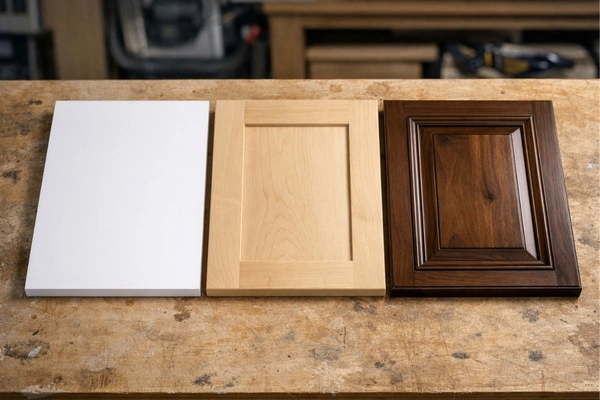
I’ve seen homeowners spend weeks agonizing over countertop materials and then get blindsided by the cabinet quote. It happens constantly. The cabinets cover more square footage than any other surface in the room, they require precise installation (a quarter-inch gap throws off the whole run), and the materials range from particle board to solid walnut. That range is where budgets blow up.
What Do Kitchen Cabinets Actually Cost?
Stock cabinets run $100–$300 per linear foot. Semi-custom options land between $200–$550 per linear foot with better durability (15–20+ year lifespan). Full custom cabinetry starts around $500 and climbs past $1,500 per linear foot, but those units can last 25 years or longer.
For a mid-size kitchen with 25 linear feet of cabinetry, the math looks like this:
| Cabinet Type | Cost Per Linear Foot | Total (25 LF) | Expected Lifespan |
| Stock | $100–$300 | $2,500–$7,500 | 10–15 years |
| Semi-Custom | $200–$550 | $5,000–$13,750 | 15–20+ years |
| Custom | $500–$1,500+ | $12,500–$37,500+ | 25+ years |
And there’s a new wrinkle in 2026. A 25% tariff on imported kitchen cabinets took effect in October 2025, with a planned jump to 50% that was delayed until 2027 per NAHB reporting. If you’re shopping imported cabinetry, those tariffs are already baked into quotes. Domestic options avoid the tariff hit, but supply hasn’t caught up to demand yet.
Does the Hardware Really Matter That Much?
More than most people expect. Soft-close hinges, full-extension drawer slides, and quality handles add $50–$150 per door or drawer. On a kitchen with 40 doors and drawers, that’s $2,000–$6,000 just in hardware. It adds up quietly.
How Does the Rest of a Kitchen Remodel Budget Break Down?
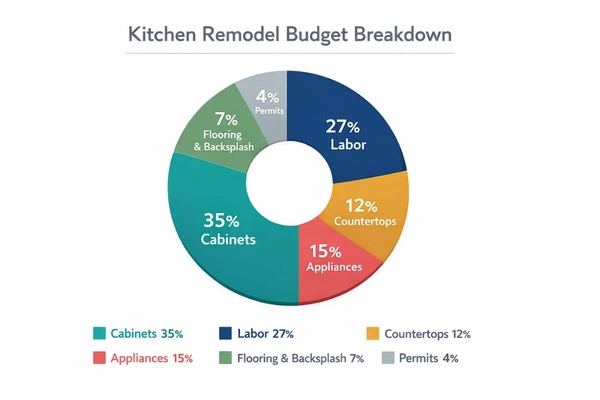
Cabinets get the biggest slice, but they don’t get all of it. The 2025 Cost vs. Value Report from the Journal of Light Construction puts a major midrange kitchen remodel at $82,793 nationally. A minor midrange remodel comes in at $28,458.
Here’s where the money typically goes:
| Category | % of Budget | Typical Cost Range |
| Cabinets | 30–40% | $5,000–$30,000+ |
| Labor (install, plumbing, electrical) | 20–35% | $4,000–$25,000+ |
| Countertops | 10–15% | $2,000–$10,000+ |
| Appliances | 10–20% | $2,500–$15,000+ |
| Flooring, backsplash, lighting | 5–10% | $1,000–$5,000 |
| Permits, design fees, contingency | 5–10% | $1,000–$5,000+ |
That last row is the one nobody talks about. Permits alone average $460–$2,770 depending on your municipality. General contractor fees run 10–20% on top of everything. And if you don’t set aside 10–15% for surprises (old plumbing, electrical that isn’t up to code, water damage behind walls), you’re gambling.
How Much Does a Kitchen Remodel Cost by Project Size?
The JLC 2025 Cost vs. Value data gives the clearest national benchmarks:
| Project Scope | Average Cost | ROI (Resale Value Recouped) |
| Minor Midrange | $28,458 | 113% ($32,141 resale value) |
| Major Midrange | $82,793 | 51% ($42,130 resale value) |
| Major Upscale | $164,104 | 36% ($58,561 resale value) |
Read that minor remodel ROI number again. 113%. You get more back than you put in. That’s rare in home improvement, and it’s why I always tell homeowners to seriously consider a targeted refresh before committing to a full gut job. Most people assume bigger equals better return. The data says the opposite.
Are Countertops the Second Most Expensive Part?
Yes, for most projects. Countertops typically claim 10–15% of the total budget, with material choice driving the range dramatically.
Laminate runs $8–$35 per square foot and lasts 10–15 years. Quartz costs $15–$70 per square foot but requires almost zero maintenance over 25+ years. Granite, marble, quartzite, and butcher block all fall somewhere in between, each with specific trade-offs around heat resistance, staining, and sealing requirements.
One pattern I’ve noticed across dozens of projects: homeowners who pick cabinets first and countertops second tend to stay on budget. The ones who fall in love with a $90/sq ft countertop slab and then try to squeeze cabinet costs to compensate? They end up unhappy with both.
Actually, that framing isn’t quite right. The real issue isn’t the order of decisions. It’s that countertops are emotional purchases (you touch them every day, you see them constantly) while cabinets feel like infrastructure. People allocate dollars based on what excites them, not what costs the most. And that’s how budgets fall apart.
What Hidden Costs Catch Homeowners Off Guard?
Moving plumbing, electrical, or gas lines is the single biggest budget killer in kitchen remodeling. A gas line relocation alone runs $375–$750, and rerouting plumbing for a new sink location averages $7,500 for new pipes. I’ve seen projects balloon 20–30% purely from layout changes that seemed minor on paper.
Permits are another one. Homeowners budget for materials and labor, then discover their city requires permits for electrical work, plumbing changes, or even cabinet installation in some jurisdictions.
And then there’s the temporary kitchen. Nobody budgets for eating out or setting up a microwave station in the garage for 8 weeks. But at $15–$25 per meal for a family of four, that’s $2,500–$5,000 over a two-month remodel. It sounds trivial until you see it on the credit card statement.
Does Kitchen Remodel Cost Change by Region?
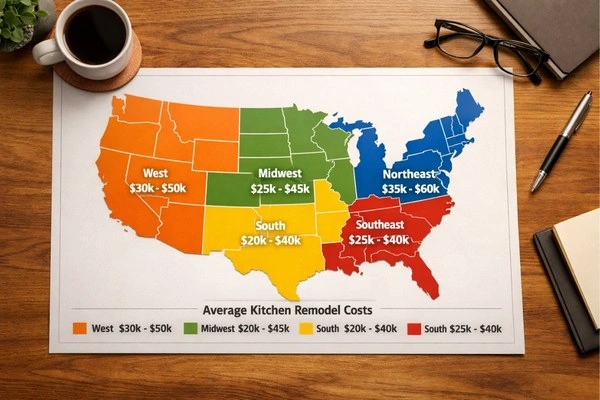
Significantly. Angi’s 2025 regional data shows just how wide the gap gets:
| Region | Typical Remodel Range |
| Midwest | $10,300–$34,300 |
| Southeast | $12,000–$32,200 |
| Southwest | $12,350–$33,950 |
| Northeast | $10,800–$40,400 |
| West/Northwest | $25,600–$61,100 |
The West Coast premium is real. A mid-size kitchen remodel that costs $30,000 in the Midwest can easily hit $55,000–$60,000 in markets like the Pacific Northwest or the Bay Area. Labor rates, material transport costs, and permit fees all skew higher.
If you’re planning a remodel and getting quotes that feel high, compare them to your region’s range before assuming you’re being overcharged. A lot of sticker shock comes from comparing local quotes to national averages that are dragged down by lower-cost markets.
How Can You Save Money on a Kitchen Remodel?
Don’t gut the layout. Seriously. Keeping your sink, stove, and refrigerator in their current positions eliminates the most expensive changes (plumbing, gas, electrical). This alone can save $5,000–$15,000.
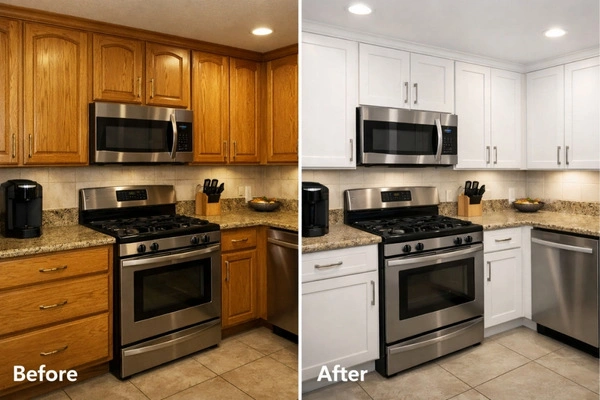
- Reface instead of replace. If your cabinet boxes are solid and you like the layout, new doors and a fresh coat of paint can save 40–50% compared to full replacement. It won’t work for everyone, but for cabinets that are structurally sound and less than 15 years old, it’s worth considering.
- Go semi-custom, not full custom. Semi-custom cabinets offer most of the style flexibility of custom work at roughly half the cost. The main trade-off is sizing. You’ll work with standard dimensions instead of quarter-inch precision. For 90% of kitchens, that’s perfectly fine.
- Buy appliances during holiday sales. Memorial Day, Labor Day, and Black Friday sales routinely discount appliances 20–35%. If your timeline allows it, buying 2–3 months before your remodel starts can save $1,000–$3,000 on a mid-range appliance package.
- Mix your materials. Quartz on the island, laminate on the perimeter counters. Nobody will notice (or care), and you’ll save $2,000–$4,000 on a typical kitchen. I’ve recommended this to homeowners who were stretching to afford quartz everywhere, and every one of them has said they’d do it again.
One thing I wouldn’t recommend: going DIY on cabinet installation to save money. The labor savings look attractive (roughly 25% of the cabinet cost), but Angi’s data shows DIY kitchen remodels take 2–6+ months versus 6–8 weeks with a pro. And there’s no warranty on your own work. A remodeling team that knows the process inside out catches problems early, which almost always saves money compared to fixing DIY mistakes later.
Should You Spend More on Cabinets or Countertops?
This depends on how long you’re staying in the home.
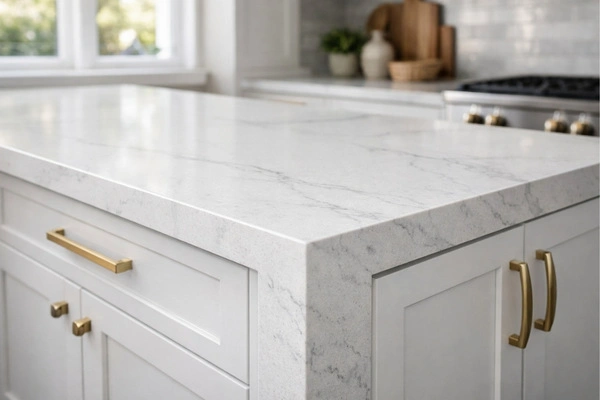
If you’re selling within 3–5 years, put more into countertops. They’re the first thing buyers notice, and they photograph well for listings. A beautiful countertop with decent stock cabinets reads better in photos than custom cabinets with laminate counters.
If you’re staying 10+ years, invest in cabinet quality. You’ll open those doors and drawers 20 times a day for the next decade. Cheap cabinets with soft-close retrofits and peeling laminate doors will frustrate you within 5 years. Good cabinets with a moderate countertop age gracefully, and you can always upgrade the countertop later without touching the rest of the kitchen.
The NKBA’s 2026 Kitchen Trends Report found that Gen X and Boomers drive the bulk of kitchen remodel spending, with 90% of Gen X homeowners and 71% of Boomers investing in their kitchens. These are people who are staying put. For that group, cabinet quality is the better bet.
How Do You Plan a Kitchen Remodel Budget That Actually Holds?
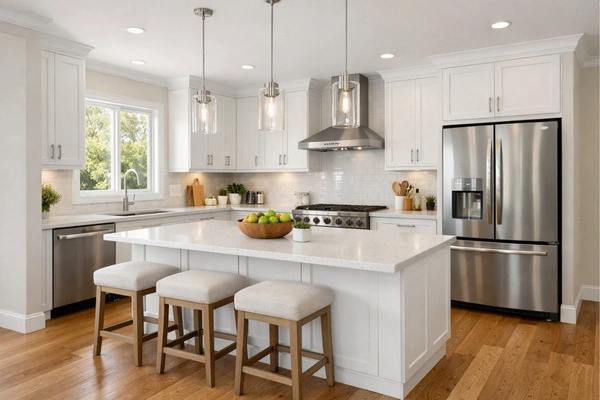
Most budget guides tell you to make a spreadsheet. That’s obvious. What actually keeps a budget intact is getting your cabinet quote first and treating it as the anchor for every other decision.
Get three cabinet quotes before you price anything else. Once you know whether you’re spending $7,000 or $25,000 on cabinetry, the rest of the budget falls into place. Countertops, appliances, and labor all scale around that number.
Set your contingency at 15%, not 10%. The industry standard is 10%, but on the projects I’ve tracked, 15% is closer to what people actually need once the walls open up and the surprises start. Older homes (pre-1990) should budget 20%.
Get phased bids. Ask your contractor to separate demolition, plumbing, electrical, cabinetry, and finishing into individual line items. This kills the most common budget trap, where a single lump-sum quote hides inflated costs in one category to subsidize another. A contractor confident in their pricing won’t push back on this request. If they do, that tells you something.
And if you’re working with a marketing partner who understands your vertical, make sure the investment in your kitchen is reflected in how your home presents online when it’s time to sell. Professional photos of a well-designed kitchen are one of the highest-ROI moves in real estate marketing.
FAQs
How much of a kitchen remodel budget goes to cabinets?
Cabinets typically consume 30–40% of your total kitchen remodel budget, making them the most expensive single line item. On a $30,000 remodel, that’s roughly $8,400–$12,000 for cabinetry alone. The exact percentage depends on whether you choose stock, semi-custom, or custom cabinets.
Is a kitchen remodel worth it for resale value in 2026?
It depends on the scope. A minor midrange kitchen remodel recoups 113% of its cost at resale, according to the JLC 2025 Cost vs. Value Report. Major remodels recover much less (51% for midrange, 36% for upscale). If resale ROI matters to you, a targeted refresh beats a full gut renovation.
What hidden costs surprise homeowners during a kitchen remodel?
The biggest surprises are plumbing and electrical relocation ($1,500–$15,000+), permit fees ($460–$2,770), general contractor overhead (10–20% of total), and temporary living expenses during construction. Older homes often have additional costs for bringing wiring and pipes up to current code.
How much does a kitchen remodel cost in different regions of the U.S.?
Costs vary dramatically by region. Angi’s 2025 data shows the Midwest ranging from $10,300–$34,300, while the West/Northwest runs $25,600–$61,100 for comparable projects. The Southeast and Southwest fall in between. Always compare quotes to your regional average, not the national number.
How do 2025–2026 cabinet tariffs affect kitchen remodel prices?
A 25% tariff on imported kitchen cabinets took effect in October 2025. A planned increase to 50% was delayed to 2027. If you’re buying imported cabinetry, expect prices to be $2,000–$5,000 higher than pre-tariff levels on a mid-size kitchen. Domestic cabinet brands avoid the tariff but may have longer lead times due to increased demand.
Should I refinish my existing cabinets or buy new ones?
If your cabinet boxes are structurally sound, refacing (new doors plus fresh paint or veneer on the boxes) saves 40–50% compared to full replacement. This works best for cabinets under 15 years old with solid frames. If the boxes are warped, water-damaged, or made of low-quality particle board, replacement is the better long-term investment.
How long does a kitchen remodel take from start to finish?
Most professional kitchen remodels take 6–8 weeks from demolition to completion. Projects that involve plumbing relocation, custom cabinetry, or permit delays can stretch to 12+ weeks. DIY kitchen remodels, by comparison, average 2–6 months according to Angi’s contractor data.

Michael Vale has over 5 years of experience helping clients improve their business visibility on Google. He combines his love for teaching with his entrepreneurial spirit to develop innovative marketing strategies. Inspired by the big AI wave of 2023, Michael Vale now focuses on staying updated with the latest AI tools and techniques. He is committed to using these advancements to deliver great results for his clients, keeping them ahead in the competitive online market.