
What Is The Most Expensive Part Of A Bathroom Remodel In 2026?
Labor and plumbing. Those two categories eat 40–65% of a typical bathroom remodel budget, and it’s not close. The national average bathroom remodel cost sits around $12,128 according to Angi’s 2026 data, with projects ranging from $2,500 for basic refreshes to $30,000+ for full gut renovations. But no matter where you fall on that scale, labor and plumbing will take the biggest bite.
The most expensive part of a bathroom remodel is the labor required for plumbing, electrical, waterproofing, and tile work. These skilled trades account for the bulk of project costs because they require licensing, code compliance, and coordination across multiple specialties.
Most guides will tell you “fixtures drive costs.” I’ve seen that repeated so many times it’s practically a meme in the remodeling space. It’s wrong. A $3,000 vanity doesn’t move the needle the way a $7,000 plumbing reroute does. This article breaks down where the real money goes, what you can control, and what you can’t. We won’t cover cosmetic-only updates (paint, mirrors, accessories) because those aren’t what blow budgets.
What Drives Bathroom Remodel Costs the Most?
Skilled labor and plumbing changes sit at the top of every bathroom remodel budget. Everything else, including tile, fixtures, and finishes, fights for whatever’s left over.
Labor Takes 40–65% of Your Budget
Labor is the single biggest line item on almost every bathroom remodel. The 2025 Remodeling Cost vs. Value Report from JLC shows a mid-range bathroom remodel runs roughly $26,138, and the majority of that goes to the tradespeople doing the work. Plumbers, electricians, tile installers, and general contractors all bill separately, and their schedules need to line up.
In high-cost markets, this gets worse fast. A master plumber in Southern California bills $85–$150 per hour. A tile specialist runs $60–$100 per hour. And because a bathroom touches plumbing, electrical, waterproofing, and finish carpentry, you’re paying for four or five different skilled trades on one small room.
How Much Does Moving Plumbing Add to a Bathroom Remodel?
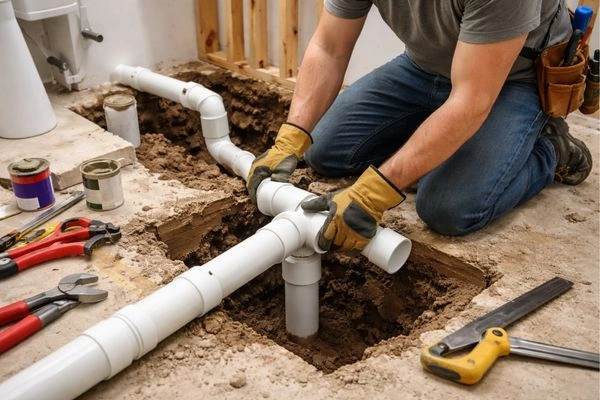
Moving plumbing is where budgets fall apart. Relocating a toilet costs $2,000–$5,000. Shifting a shower or tub runs $3,000–$8,000. Even a simple sink move can add $1,500–$4,000. These numbers come from contractor pricing aggregated by Morey Remodeling and line up with what I’ve seen across dozens of projects.
Here’s the part most homeowners miss. Each plumbing move requires rerouting water supply lines AND drain lines, pulling permits, passing inspections, and (in homes with slab foundations) cutting concrete. It’s not just expensive. It’s time-consuming, and time means more labor costs.
If your plumber finds corroded pipes or water damage during demo, that budget buffer you planned? Gone.
Why Labor and Plumbing Outpace Everything Else
Labor spans every single phase of a bathroom remodel. Demo, rough-in plumbing, electrical, waterproof membrane, tile, fixture install, finish trim. A plumber alone might bill 20–30 hours on a mid-range project. The tile installer bills another 30–40 hours. Stack on the electrician, the GC’s overhead, and permit-related inspection delays, and it’s clear why materials end up being the smaller piece.
Actually, the better way to think about it is this. Materials are a one-time purchase you can shop around on. Labor is a fixed cost tied to the complexity of what you’re asking tradespeople to do. And bathrooms, per square foot, are the most trade-intensive rooms in a house.
Other Costs That Add Up Fast
Labor and plumbing dominate, but a few secondary categories can run up the total if you’re not watching them.
Tile, Waterproofing, and the Wet Area
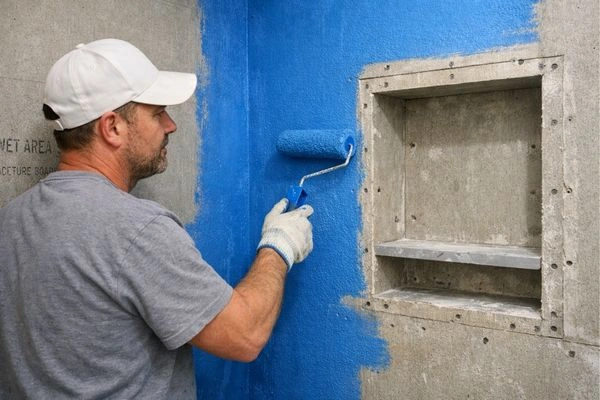
The shower/tub zone is the second most expensive area in a bathroom remodel. It requires a waterproof membrane, properly sloped drainage, ventilation, and wall-to-wall tile coverage. Custom tile with stone finishes can push wet area costs past $10,000 on their own. Porcelain and ceramic tile run $5–$15 per square foot. Marble and natural stone? $20–$40 per square foot. And the labor to install tile is slow and precise, which drives hours up.
Wet rooms are gaining popularity too. The Houzz 2025 Bathroom Trends Study found that open, fully waterproofed shower spaces are trending, with 83% of homeowners now including eco-friendly features in their bathroom remodels.
Fixtures, Vanities, and Countertop Costs
Fixtures, vanities, and countertops are the costs homeowners obsess over, but they’re rarely the biggest budget item. Stock vanities run $500–$2,000. Custom-built vanities with quartz or granite tops can hit $5,000–$10,000. Premium faucets, rain showerheads, and smart toilets add another $1,000–$7,500.
These items matter. But on a $26,000 mid-range project, they’re typically 15–25% of the total. Labor and plumbing are 40–65%. The math isn’t subtle.
How Much Does a Bathroom Remodel Cost in 2026?
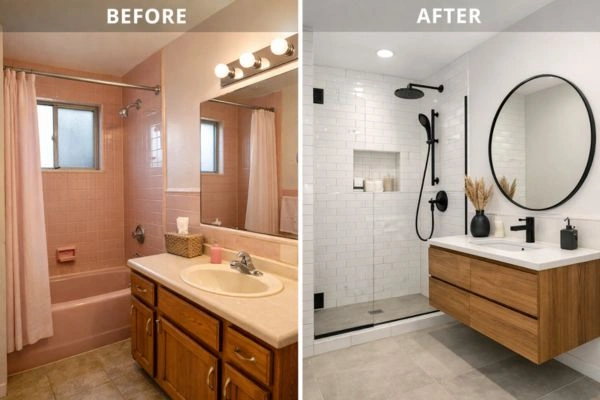
The national average is $12,128 per Angi’s 2026 data. But that average hides a lot. Here’s how costs break down by tier.
| Project Tier | Typical Cost Range | What’s Included |
| Budget / Basic | $6,000–$15,000 | Stock fixtures, same layout, cosmetic updates |
| Mid-Range | $25,000–$27,000 | New fixtures, some layout changes, quality tile |
| Upscale / High-End | $50,000–$82,000 | Full gut, layout changes, premium everything |
The JLC 2025 Cost vs. Value Report puts a mid-range bathroom remodel at $26,138 with 80% cost recouped at resale. An upscale remodel? $81,612 with only 42% recouped. That’s a massive ROI gap.
Regional costs swing wildly too. High-cost markets like Orange County, CA see bathroom remodels running $25,000–$60,000, roughly double the national average. If you’re in a lower-cost area, $14,000 or less is common for a solid mid-range project.
How to Cut Bathroom Remodel Costs Without Cutting Corners
The biggest savings come from one decision. Keep the toilet, shower, and sink where they are.
Skipping plumbing relocation saves $5,000–$10,000 on most projects. That’s not a minor win. That’s the difference between a budget remodel and a mid-range one.
Beyond layout, porcelain tile gives you 90% of the look of natural stone at 40–60% less cost. Stock vanities from quality manufacturers look great and install in a fraction of the time custom pieces require. Refinishing an existing tub instead of replacing it saves $2,000–$4,000.
Get three bids minimum. I’ve seen quotes for the same scope vary by 35% between contractors in the same city. And don’t skip the contingency fund. Set aside 10–15% of your total budget for surprises behind the walls. Corroded pipes, mold, outdated wiring. Something always comes up.
Working with a remodeling team that plans strategically from day one makes the difference between a project that stays on budget and one that spirals.
The most expensive part of a bathroom remodel will always be the labor and plumbing. You can’t shortcut licensed trades or skip code compliance. But you can make smart layout decisions, choose cost-effective materials, and plan for the unexpected. That’s how you get a great bathroom remodel without a devastating bill.
FAQs
Why is labor the most expensive part of a bathroom remodel?
A bathroom remodel requires plumbing, electrical, waterproofing, and tile work, all done by licensed tradespeople. Labor accounts for 40–65% of total project costs because these trades bill separately, require code inspections, and must coordinate schedules around each other.
How much does it cost to move plumbing in a bathroom?
Relocating a toilet typically costs $2,000–$5,000, while moving a shower or tub runs $3,000–$8,000. A simple sink move adds $1,500–$4,000. These costs include rerouting supply lines, drain lines, permits, and inspections.
What is the average bathroom remodel cost in 2026?
The national average is $12,128 according to Angi’s 2026 data. Budget projects start around $6,000, mid-range remodels average $26,138 per the JLC 2025 Cost vs. Value Report, and upscale renovations can exceed $81,000.
How can I save money on a bathroom remodel without sacrificing quality?
Keep fixtures in their current locations to avoid $5,000–$10,000 in plumbing relocation costs. Choose porcelain tile over natural stone (40–60% savings), use stock vanities instead of custom builds, and get at least three contractor bids. Always set aside 10–15% for unexpected issues behind the walls.
What ROI does a bathroom remodel provide at resale?
A mid-range bathroom remodel recoups about 80% of its cost at resale according to the JLC 2025 Cost vs. Value Report. Upscale remodels only recover roughly 42%. For the best return, stick to mid-range finishes and avoid over-improving for your neighborhood.
Are wet rooms more expensive than traditional showers?
Yes. Wet rooms require full-floor waterproofing, sloped drainage across the entire bathroom floor, and more extensive tile coverage. But they’re growing in popularity for accessibility and modern design, with the Houzz 2025 study reporting increased adoption alongside eco-friendly bathroom features.
Does the region I live in change bathroom remodel costs?
Significantly. High-cost markets like Orange County, CA see bathroom remodels running $25,000–$60,000, roughly double national averages. Lower-cost areas can complete solid mid-range projects for $14,000 or less. Local labor rates and permit requirements are the primary drivers of regional price differences.

Michael Vale has over 5 years of experience helping clients improve their business visibility on Google. He combines his love for teaching with his entrepreneurial spirit to develop innovative marketing strategies. Inspired by the big AI wave of 2023, Michael Vale now focuses on staying updated with the latest AI tools and techniques. He is committed to using these advancements to deliver great results for his clients, keeping them ahead in the competitive online market.